Why a Village Green Often Becomes the Natural Pause
A village green can make a countryside walk easier to read, offering a place to pause, orient yourself and notice how local streets meet.
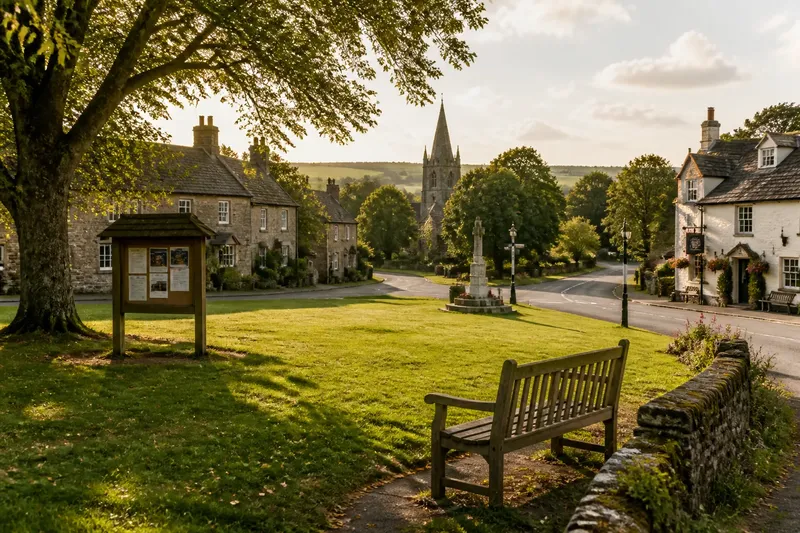
You reach a bend in a village lane, hear traffic soften, and see a stretch of grass beside a few benches and a noticeboard. A village green can become the natural pause in a walk: a place to stop, orient yourself and notice how the surrounding streets fit together. Its usefulness lies less in any standard design than in the way that particular open space meets the village around it.
What makes a green a pause?
A village green is an open space within or beside a settlement, often bordered by homes, lanes or community buildings. The term does not promise a particular size, shape, planting scheme or set of facilities. Some greens are broad lawns; others are modest patches of grass with a path crossing them.
For a walker, the pause begins when movement through a narrow street gives way to a more open view. You can stop without standing in a doorway or blocking a pavement, let other people pass, and look back at the route you have taken. That change in space makes the green a useful threshold between one part of a village and another.
It need not be a formal attraction. A green with no café, sculpture or marked trail may still offer a clear view of a church tower, a row of cottages or the road leading towards the fields. The pause is valuable because it lets those ordinary features register.
How can it orient a walk?
A green can work as a visual reference point when nearby lanes meet or change direction. From its edge, a walker may be able to see a landmark that was hidden among buildings, such as a church, a pub sign or a distinctive bend in the road. Looking across the space can make the village’s layout easier to understand than studying a map while walking.
Use fixed features rather than assuming that every path across the grass is a public route. Notice which streets lead away from the green, where a footpath sign points, and whether a lane appears to continue towards open countryside. A map or route description can then confirm which way to go.
Say you have followed a lane from the bus stop and arrive at a green where three roads meet. You pause beside the noticeboard, identify the church spire to your left and compare the signed footpath with your map; the expected result is a clearer choice of lane before you leave the village centre.
Keep the pause simple: step aside from the main path, look around, then decide whether you need to check your route. A short stop can prevent a longer spell of uncertain wandering.
What should you notice?
Start with the edges. A green’s boundaries often tell you how it relates to the village: houses may face directly onto it, a lane may curve around one side, or a hedge may separate it from fields. These details show where everyday movement is concentrated and where the settlement opens towards the countryside.
Then look for signs of shared use. A bench, a play area, a memorial, a noticeboard or a worn crossing can suggest how people pass through or spend time there. Their presence does not make every green a public event space, and an empty lawn is not an invitation to cross private ground. Read posted notices and visible paths before settling in.
Sound can also help you read the place. The green may be quieter than the road, or it may sit beside a busy junction, a school entrance or a playing field. Listen before choosing where to stop; a bench facing away from traffic may suit a pause better than the most prominent seat.
Look beyond the grass as well. A line of roofs, a lane narrowing towards a bridge, or a gap in a hedge can give the open space a direction. The green is not a detached patch of scenery; its character often comes from the buildings, routes and views gathered around it.
Where is a good place to stop?
Choose a spot that leaves the main route clear and does not take over a space others are using. A bench is convenient if it is available, but the edge of a low wall or a quiet corner can work just as well for a brief rest. Avoid sitting on memorials, blocking gates or spreading belongings across a path.
Notice the ground before you settle. Grass may be wet, muddy or worn, while a paved edge can be more comfortable after rain. If the green is being used for a game, gathering or local activity, give participants room and choose another point for your pause.
Shade and exposure vary from one green to another. A tree may offer shelter on a warm day, while an open centre may feel exposed to wind. Rather than assuming the middle is the best place, take in the weather, the surface and the flow of people, then stop where you can remain comfortable without obstructing anyone.
How does each green differ?
A village green is not a standard feature with a standard purpose. One may be a broad, level lawn at the centre of the settlement; another may be a sloping verge beside a lane, with a bench and a view over a valley. Some have paths, play equipment or a noticeboard, while others are little more than open ground framed by cottages.
Those differences affect what the space can offer a walker. A central green can help you compare several streets at once, while a green at the edge of a village may mark the transition from houses to fields. A small roadside space might provide a convenient pause but little room to linger.
Do not judge a green by its size or facilities alone. Its position, sightlines and relationship to the route may matter more than whether it appears on a visitor map. A modest space can be a useful landmark if it sits at a clear junction; a larger one may feel less connected to your walk.
What should you check before lingering?
Look for signs about access, dogs, events or restrictions, and follow any instructions displayed locally. If a route crosses the green, stay on the recognised path where one is evident rather than cutting across planted areas. Where access or ownership is unclear, choose the public path or ask locally instead of assuming that open grass is unrestricted.
Consider the green’s daily use, too. A school may be letting out, a local group may be setting up, or a game may be under way. A pause should fit around that activity, not interrupt it; if the space is busy, continue to a quieter lane or public path.
Leave the place as you found it. Take wrappers and food waste with you if there is no suitable bin, keep dogs under control, and avoid disturbing plants or wildlife at the edges. Small acts of care matter particularly in shared spaces where residents may use the same route every day.
Can a green replace a map?
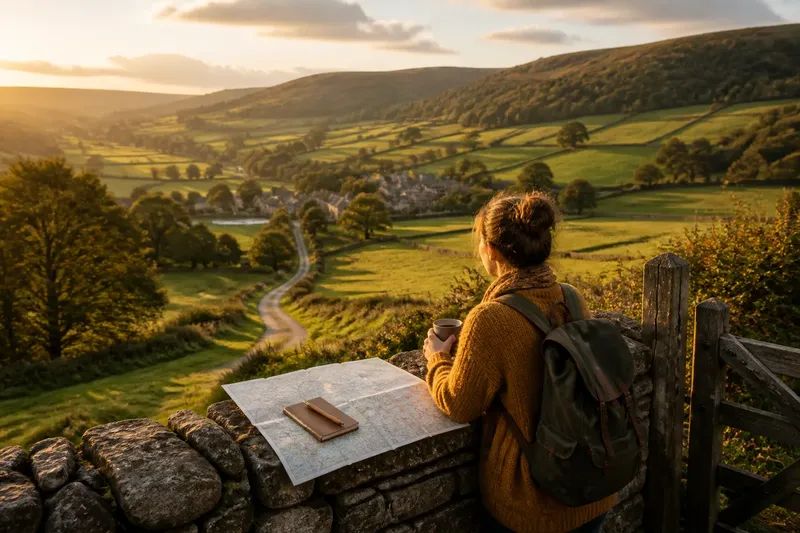
No. A green can help you orient yourself, but it does not show every footpath, boundary or change in access. Use a current map or reliable route information for the walk, and treat the green as a useful point for checking your bearings rather than as proof that a visible track continues where you expect.
If you lose your sense of direction, stop somewhere that does not obstruct others and compare nearby landmarks with the route information. A road name, signed path or recognisable building is more dependable than guessing from the direction of the open fields. If the intended route is not clear, retrace to the last point you can identify.
Why do greens feel different?
The same basic pause can feel quite different depending on the village. A green enclosed by houses may bring doorways, gardens and local notices into view; one beside a church may make the tower and churchyard the main reference points. At the edge of a settlement, the open space may instead frame a view towards farms, woodland or a valley.
Season and weather change what you notice without changing the layout. In leaf, trees can screen a lane; in winter, bare branches may open the view. After rain, a grassy crossing may be sodden, so the paved perimeter becomes the more comfortable way around.
Allow the place to set the pace. You do not need to turn every green into a destination or spend a fixed amount of time there. A glance, a brief rest or a route check may be enough before the walk continues.
Which questions help you decide?
Is a village green always public?
No; the name or appearance alone does not establish access rights. Check signs and recognised paths, and respect any local restrictions or private boundaries.
Can I walk across the grass?
Only if access is permitted and the ground is suitable. Follow a visible public path where possible, and avoid crossing planted, muddy or actively used areas.
Is a green a useful meeting point?
It can be, especially when it is easy to identify from nearby streets. Agree on a specific feature, such as the noticeboard or bench, rather than saying only “the green” if the space has several entrances.
What if there is no bench?
A bench is not essential to a useful pause. You can stop briefly at a clear, unobstructed edge, check your bearings, and move on if the ground or surrounding activity makes lingering uncomfortable.
Let the pause stay local
A village green is most revealing when you read it in relation to its own streets, paths and surroundings. Notice which way the lanes run, what the open space faces and how people use it, then choose a pause that respects the place. That is the simple value of a village green: it gives a walk room to breathe while helping the village itself come into view.
Before setting off again, take one last look at the route marker or map and choose the next clear landmark. The village green can steady your sense of direction, but the next lane, bridge or signed path is what carries the walk onward.